Why does my house feel stuffy?
Usually because too little fresh air is getting in, the air is too humid, or air is not moving well through the ducts. A tight house with no mechanical ventilation, humidity above 50 to 60 percent, a clogged filter, closed vents or leaky ducts are the common causes. Check humidity, the filter and the exhaust fans first, and make sure your carbon monoxide alarms work.
Free to ask. Local shops send quotes, and you pay only when you book one.
By Kasra Taheri, Founder, LoclisUpdated
Researched and drafted with AI, then checked claim by claim against the sources listed below before it was published. Prices and rules change; the dates beside each source say when it was last checked.
Step by step
Read when to stop and call a pro, further down this page, before you start.
Step 1: Measure the humidity
Hang a hygrometer in the stuffy room and on another floor; a reading consistently above 50 percent is a likely culprit.[5]
Step 2: Check the filter
Pull the furnace or air handler filter and change it if it is grey and matted, since a dirty, overloaded filter will not work well.[8]
Step 3: Open the vents
Make sure supply registers in the stuffy room are open and that furniture, rugs or curtains are not covering them or the return grilles.
Step 4: Run the exhaust fans
Run the bath fan during and after showers and the kitchen fan while cooking, and check that each one vents outside.[4]
Step 5: Air the house out
Open windows on opposite sides of the house for a short while when the outdoor air is clean and dry enough.[2]
Step 6: Dry out a damp basement
Run a dehumidifier with the basement doors and windows closed, and empty or drain it so it keeps running.[5]
Step 8: Test the CO alarms
Press the test button on each carbon monoxide alarm and make sure there is one near every sleeping area.[12]
Step 9: Note the pattern
Write down when the stuffiness or any headaches happen and whether they fade when you leave the house.[1]
A house usually feels stuffy for one of three reasons: not enough fresh air is getting in, the air holds too much moisture, or air is not moving well through the rooms. Most of the checks are free and take an afternoon. Start with humidity and the filter, then work through the list below.
Not enough fresh air
The EPA explains that if too little outdoor air enters indoors, pollutants can accumulate to levels that can pose health and comfort problems.[1] Odors and moisture from cooking and showers build up when there is nowhere for them to go.
Your heating and cooling system probably does not help here. The EPA notes that most home heating and cooling systems, including forced air heating systems, do not mechanically bring fresh air into the house.[2] They recirculate the same air. Fresh air comes in through leaks and open windows, which is why homes built to keep outdoor air from leaking in and out, without special mechanical ventilation, may have higher indoor pollutant levels.[1] Well-sealed and recently weatherized houses often feel this way.
For a sense of scale, the EPA says ASHRAE recommends that homes get 0.35 air changes per hour but not less than 15 cubic feet of air per minute (cfm) per person[3] as a minimum. You cannot measure that yourself, but an HVAC contractor can.
Leaks are not the answer either. Virginia Cooperative Extension points out that a leaky building is no assurance of good indoor air quality,[4] and that natural ventilation is mostly unreliable and uncontrolled air movement[4] that can bring moisture with it. Open windows help for an hour; they are not a ventilation system.
Too much humidity
Damp air feels heavy and warm even when the thermostat says otherwise. ENERGY STAR describes the first level of a damp space as "Slightly to Moderately Damp : space feels damp and has musty odor that may be intermittent. 50-75% relative humidity",[5] and says the optimum RH level for a building is generally considered to be between 30% and 50%.[5] The EPA's target is below 60 percent (ideally between 30 and 50 percent).[6] Humidity also makes other problems worse: High temperature and humidity levels can also increase concentrations of some pollutants.[1]
The usual sources are showers, cooking, laundry and a damp basement or crawl space. The EPA's simplest fix: Run the bathroom fan or open the window when showering.[6] Check where that fan goes, though. Virginia Cooperative Extension says most building codes require bath and kitchen exhaust fans to vent to the outside, not just into an attic or crawl space,[4] and a fan that dumps into the attic only moves the problem.
In a damp basement, a dehumidifier works best with the space closed off: Doors and windows to the space being dehumidified should be closed while the unit is running.[5] ENERGY STAR says a whole-home dehumidifier carries significant benefits for relatively well sealed homes with central air systems that see humidity readings above 55% consistently throughout the house.[5]
Air is not moving
Ducts. ENERGY STAR lists as a sign of poorly performing ducts that you have stuffy rooms that never seem to feel comfortable,[7] and says about 20 to 30 percent of the air that moves through the duct system is lost due to leaks, holes, and poorly connected ducts.[7] ENERGY STAR lists ducts located in an attic, crawlspace, or the garage as another warning sign.[7] Where you can reach them safely from a basement or utility-room floor, ENERGY STAR says to seal air leaks using mastic sealant or metal tape,[7] adding: "Never use duct tape, as it is not long-lasting."[7]
Vents and doors. A closed register, a sofa over a floor vent, or a bedroom door kept shut with no return grille often leaves one room stale while the rest of the house is fine.
The filter. In the EPA's words, if a filter is dirty and overloaded, it won't work well.[8] A clogged filter cuts airflow everywhere. See how often to change your furnace filter and which MERV rating to use.
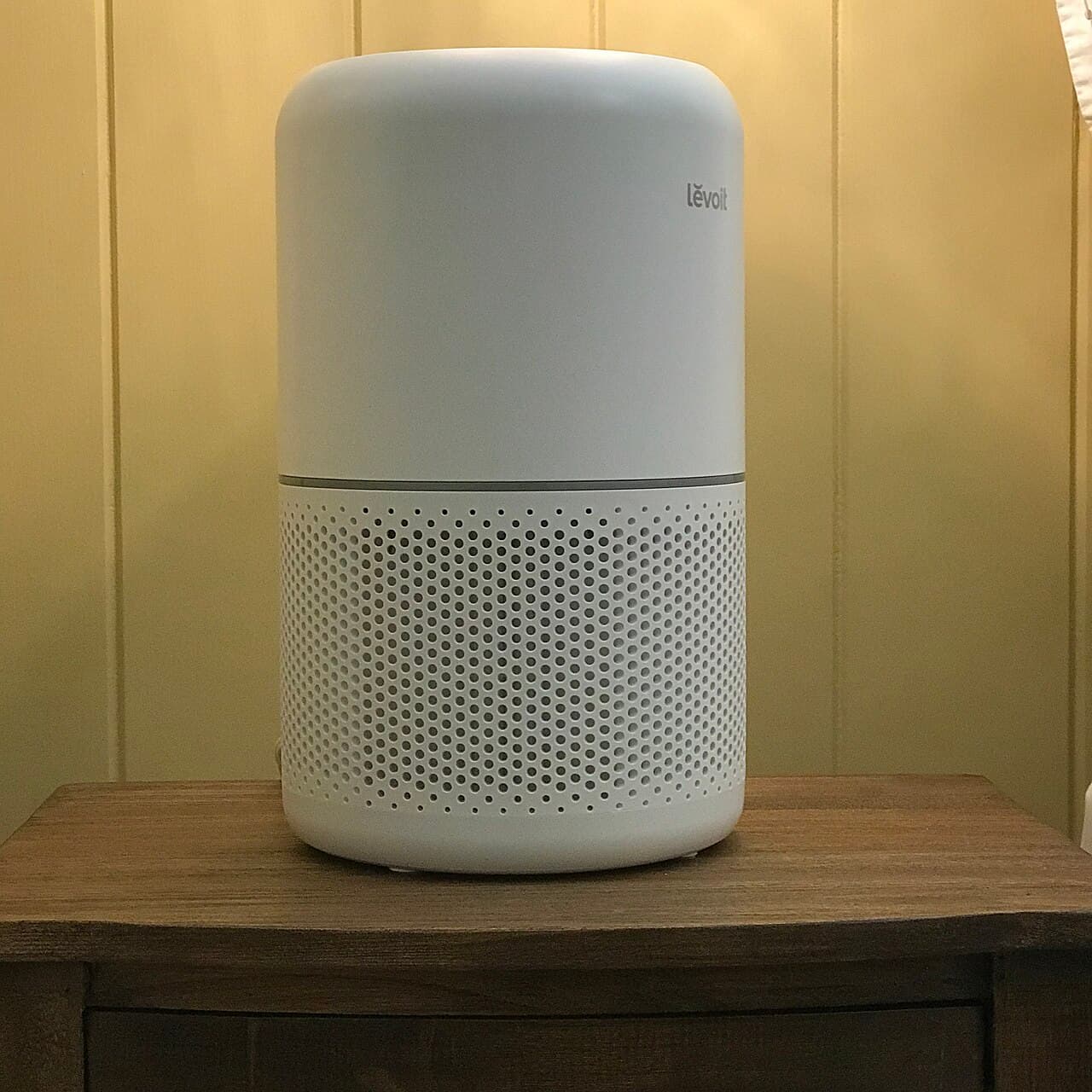
A portable air purifier like this one catches dust and pollen, but it will not fix stale or humid air on its own.
Something is giving off fumes
New paint, a refinished floor, new furniture or a shelf of solvents can make a house feel close. The EPA lists short-term effects of indoor pollutants as irritation of the eyes, nose, and throat, headaches, dizziness, and fatigue.[1] Its advice for telling indoor causes apart from a cold: If the symptoms fade or go away when a person is away from the area, for example, an effort should be made to identify indoor air sources that may be possible causes.[1]
Carbon monoxide is a colorless, odorless gas,[12] so you will not notice it as stuffiness, but its symptoms overlap. The EPA lists headaches, dizziness, sleepiness, coughing, and watery eyes[9] among the symptoms of combustion pollutants. Make sure you have a working CO alarm in the hallway near every separate sleeping area.[12]
Stop and call a pro if
- A CO alarm sounds, or people feel dizzy or sick at home. The EPA says to get fresh air immediately, open windows and doors, turn off any combustion appliances and leave the house,[9] then get medical help and have the appliances inspected.
- You smell gas. Columbia Gas of Virginia says a sulfur or rotten-egg-like odor could mean a gas leak: get out immediately, do not use anything that could cause a spark, like a phone, light switch, appliance or flashlight, and call 911 and your gas company from a safe location away from the building.[11]
- Humidity stays high while the air conditioning runs. That points to the system's sizing, airflow or drainage, which an HVAC technician should check.
- The vents smell musty. Do not keep running a system you think has mold in it; have it inspected.
- The ducts are wrapped in old tape, paper-like wrap or insulation. A heating and cooling system can contain asbestos-containing materials, such as insulation and register boots, and the EPA says those materials should not be disturbed or removed except by specially trained and equipped contractors.[10] Do not cut, scrape or seal over old duct wrap you cannot identify; have it checked first.
- Reaching the ducts means crawling over attic joists or into a tight, wet crawl space. Leave that inspection to an HVAC contractor.
- One room never gets comfortable. Ducts are often hidden in walls and ceilings, and ENERGY STAR notes that most heating and cooling equipment contractors also repair ductwork.[7]
- You want mechanical fresh-air ventilation or a whole-home dehumidifier. Virginia Cooperative Extension says a whole-house ventilation system must be correctly sized by a qualified or licensed HVAC company.[4]
Getting help
For the full list of fixes, see how to improve indoor air quality at home, and if you want something measured, who to call to test your indoor air. Loclis lists DPOR-licensed HVAC businesses with their licence number and class: look up HVAC businesses in Blacksburg, browse indoor air quality services, or read all heating and cooling answers.
If the system or the ducts need a look, describe the problem once and licensed local HVAC businesses quote it.
Common questions
- Why does my house feel stuffy in winter?
- In winter the windows stay shut and the house relies on leaks for fresh air, so cooking, showers and people add moisture and odors with less air to dilute them. Running kitchen and bath fans that vent outside, and airing the house out briefly on milder days, usually helps.
- Why does my house feel stuffy with the AC on?
- Often it is humidity. ENERGY STAR says the optimum humidity for a building is generally considered to be between 30 and 50 percent, and that a space that feels damp with an on-and-off musty smell is usually at 50 to 75 percent. If a hygrometer reads high while the AC runs, have an HVAC technician check the system and its airflow.
- Why is only one room stuffy?
- A single stuffy room usually points to airflow: a closed or blocked register, a door that stays shut, or a duct that is crushed, kinked or leaking. ENERGY STAR lists stuffy rooms that never seem comfortable as a sign of poorly performing ducts.
- Will an air purifier fix a stuffy house?
- Not by itself. A purifier removes particles such as dust and pollen, but stuffiness usually comes from stale or humid air, which needs ventilation or dehumidification.
- Can stuffiness be carbon monoxide?
- The EPA describes carbon monoxide as a colorless, odorless gas, so you would not notice it as stuffiness, but the EPA lists headaches, dizziness and sleepiness among combustion pollutant symptoms. If people feel that way at home, check your CO alarms, and if you suspect CO, get everyone outside.
Sources
- [1] Introduction to Indoor Air Quality, U.S. Environmental Protection Agency. Checked October 26, 2026.
- [2] Improving Indoor Air Quality, U.S. Environmental Protection Agency. Checked October 26, 2026.
- [3] How much ventilation do I need in my home to improve indoor air quality?, U.S. Environmental Protection Agency. Checked October 26, 2026.
- [4] ENERGY SERIES: What about Ventilation? (2908-9024), Virginia Cooperative Extension, Virginia Tech. Checked October 26, 2026.
- [5] Dehumidifiers, ENERGY STAR, U.S. Environmental Protection Agency. Checked October 26, 2026.
- [6] A Brief Guide to Mold, Moisture and Your Home, U.S. Environmental Protection Agency. Checked October 26, 2026.
- [7] Duct Sealing, ENERGY STAR, U.S. Environmental Protection Agency. Checked October 26, 2026.
- [8] Guide to Air Cleaners in the Home, U.S. Environmental Protection Agency. Checked October 26, 2026.
- [9] What do I do if I suspect that combustion appliances are affecting my health?, U.S. Environmental Protection Agency. Checked October 26, 2026.
- [10] Should You Have the Air Ducts in Your Home Cleaned?, U.S. Environmental Protection Agency. Checked October 26, 2026.
- [11] Report Gas Leaks, Columbia Gas of Virginia. Checked October 27, 2026.
- [12] What about carbon monoxide detectors?, U.S. Environmental Protection Agency. Checked October 26, 2026.
Want a pro to handle it?
Describe the job once. Licensed local businesses send quotes, and you pay only when you book one.
Get a quote for HVAC Repair