How much does driveway plowing cost per storm in Virginia?
There is no standard Virginia rate per storm. Each company sets its own price, and it depends on the driveway's length, width, slope and surface, how deep the snow gets, how many pushes the storm needs, how fast you want it done, and whether the street plow's ridge, walks and de-icing are included. Compare written quotes that spell out what one storm covers.
Free to ask. Local shops send quotes, and you pay only when you book one.
By Kasra Taheri, Founder, LoclisPublished
Researched and drafted with AI, then checked claim by claim against the sources listed below before it was published. Prices and rules change; the dates beside each source say when it was last checked.
Step by step
Read when to stop and call a pro, further down this page, before you start.
Step 1: Measure the driveway
Note its rough length and width, the slope, any curves or turnaround, and whether it is paved or gravel.
Step 2: List the extras you want
Decide whether you also want the apron, a parking pad, walks, steps or mailbox access cleared, since hand work is usually priced on top.
Step 3: Ask how a storm is priced
Ask whether the price is per push, per storm or tiered by depth, and how many pushes a long storm can include before it costs more.
Step 4: Ask about the trigger depth
Find out how many inches it takes before they come out; on Virginia roads, plowing generally begins when 2 inches or more of snow has accumulated.[1]
Step 5: Ask about the street ridge
Ask whether a return trip to clear the ridge the street plow leaves across the driveway end is part of the storm price.[1]
Step 6: Ask about de-icing
Ask whether salt or sand is extra, how it is charged, and what product is spread near your lawn and beds.[7]
Step 7: Ask about gravel
On a gravel driveway, ask how they set the blade to avoid pushing stone off the surface, and who puts it back in spring.[6]
Step 8: Get it in writing
Get a written quote that lists the storm price, what is included, every extra charge and how either side can cancel.[10]
There is no standard Virginia price for plowing a driveway per storm. Each company sets its own, and two quotes for the same driveway can look far apart until you read what each one covers. The price comes down to the driveway itself, how much snow falls, how many times the storm has to be cleared, how fast you need to get out, and what else is included: the street plow's ridge, walks, steps and de-icing. A written quote that spells out what "one storm" means is how you compare them.
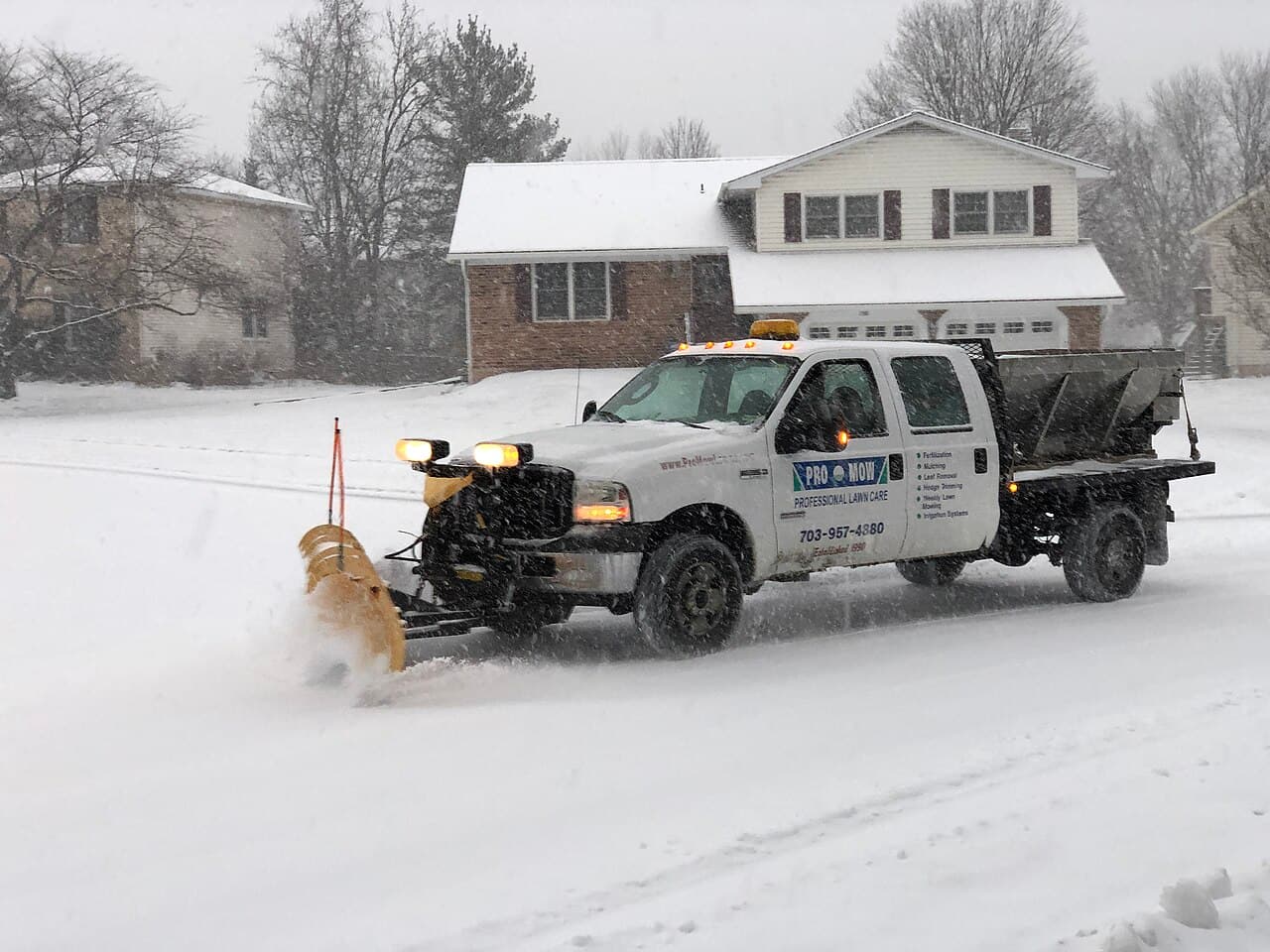
How companies price a storm
Residential plowing is usually sold one of four ways:
- Per push. One trip to clear the driveway. A long storm may need two or three pushes, each billed.
- Per storm. One price for everything a storm needs, however many trips. Some companies cap the trips or the depth.
- By depth tier. One price up to a set depth, a higher one for deeper snow. Read where the tiers break and who measures.
- Seasonal. A flat fee for the winter, sometimes with a visit cap. See whether a seasonal contract is worth it.
Per-storm and per-push prices can be the same number on paper and very different bills in a 14-inch storm. Ask how many pushes are included, and whether they plow during a long storm or wait until it ends.
What drives the price
The driveway. Length, width and slope matter most. A short, flat, paved driveway in a subdivision is a few minutes' work for a truck. A long rural lane, a steep drive, tight curves, a turnaround or a driveway with nowhere to pile snow takes longer and more skill. Walks, steps and stoops are usually done by hand and add labor.
The surface. Gravel takes more care than pavement. On gravel roads, traffic loosens stone from a gravel surface and displaces it toward the shoulders, and winter plowing operations move gravel off the surface too.[6] A careful operator works slower and leaves a thin layer of snow rather than scraping, and some companies charge to rake or blade stone back in spring. For what that damage looks like, see why a plow tears up lawn or gravel.
The depth. Most companies have a trigger depth, and there is a reason. On Virginia's state roads, plowing generally begins when 2 inches or more of snow has accumulated.[1] The City of Richmond explains that plowing is most useful when the total snow accumulation is above 2 inches, and when snowfall is less than 2 inches, or the accumulation is mostly ice, plow blades are not as effective.[3] Below the trigger, the job is usually salt or sand, priced separately. Above it, wet heavy snow and deep storms take longer and may move you into a higher tier.
Timing. Being cleared before you leave at 6 a.m. is a different job from being cleared sometime the next day. A promised response time, early-morning service or plowing during the storm usually costs more, because the company can only be in one driveway at a time.
The street ridge. On public roads, crews push snow off the road, to the right, where it can end up in gutters, on road shoulders, and can sometimes block driveways, VDOT explains.[1] On city streets it can arrive late: in Richmond, plows typically reach neighborhood streets within 48 to 72 hours after snowfall ends.[3] Alexandria tells residents to be prepared to clear driveways and sidewalks more than one time.[4] If the company clears your driveway before the street is plowed, the heavy ridge lands after they leave. Ask whether a return trip is in the storm price or billed as another push.
De-icing. Salt and sand are often an add-on, charged per application or per bag. Treatment has a cost to your yard as well: Virginia Cooperative Extension notes that salt accumulation in the soil usually occurs within 30-50 feet of roads, and suggests a 50/50 mix of sand and granular de-icer, or calcium, potassium or magnesium products instead of sodium-based ones.[7] Ask what the company spreads, and keep it off the beds.
How many storms you are paying for
A per-storm price only means something next to the number of storms. Snowfall in Virginia swings widely. At Washington Dulles, the National Weather Service lists a normal season of 21.0 inches, but recorded 0.4 inches in 2022-23, 52.8 inches in 2013-14 and 73.2 inches in 2009-10.[5] Recent winters there were closer to the middle, with 11.7 inches in 2023-24 and 15.5 inches in 2024-25.[5] Southwest Virginia's mountains, the Shenandoah Valley and Hampton Roads all differ, often a lot. The point holds everywhere: in some winters you pay for one or two storms, in others for many, which is the case for and against paying by the storm.
Comparing quotes
Put the quotes side by side and check that each one answers the same questions:
- Which areas are included: driveway, apron, parking pad, walks, steps, mailbox access.
- The pricing model, the trigger depth, and what happens above it.
- How many pushes one storm includes, and whether they come during the storm.
- Whether the street ridge is cleared, and at what cost.
- De-icer or sand: included or extra, and which product.
- Who pays for damage to lawn edges, gravel, pavement or the mailbox.
- Proof of insurance. Even VDOT requires vehicle insurance for each piece of equipment from contractors who plow for the state.[2]
For the full list of terms, see what a snow plowing contract should include.
Door-to-door offers after a storm
People with plows knock on doors after big storms. If you agree to a sale someone solicited in person at your home, Virginia's Home Solicitation Sales Act generally lets you cancel until midnight of the third business day after you sign.[9] The cancellation must be in writing, sent to the seller at the address in the agreement,[9] and the seller has to give you a copy of the contract and a written notice of your right to cancel.[10] Cash sales of less than $25 are not covered,[8] and the right can be lost if you asked for emergency service and signed a dated waiver.[9] Settle the price before anyone starts.
Doing it yourself instead
For a short paved driveway, a shovel or a snow blower and an early start are often enough; see the best way to clear a driveway after a big snow. Marking the edges before the ground freezes helps whether you or a hired plow does the work; see how to mark a driveway for a snow plow.
Stop and call a pro if
- The driveway is long, steep, curved or gravel, and a shovel or small blower cannot keep up.
- A medical condition makes heavy shoveling a risk for you.
- You need to be out by a set time after every storm.
- There is nowhere left to put the snow and it has to be hauled away; see snow hauling.
Browse driveway plowing services and snow and seasonal answers, find seasonal services around Blacksburg, or describe your driveway once and local businesses quote it.
Common questions
- Is a per-storm price better than a per-push price?
- A per-storm price puts the risk of a long storm on the company: one price however many trips it takes. A per-push price is cheaper for a quick 3-inch snow and more expensive for a storm that needs clearing twice and then again after the street plow passes. Ask for both prices for the same driveway and compare them against the kind of storms your area gets.
- Will they come for an inch of snow?
- Usually not unless the agreement says so. Most plow services have a trigger depth, often a couple of inches, because a blade does little on a thin layer or on ice. Light snow and ice are usually handled with salt or sand, which many companies price as a separate service.
- Why does a gravel driveway cost more to plow?
- It takes more care. A blade set too low pushes stone into the lawn, so the operator has to work slower and leave a little snow on the surface, and a long gravel lane often has soft edges and ditches to avoid. Some companies also charge to put displaced gravel back in spring.
- Do I pay again when the street plow buries the end of my driveway?
- Only if the agreement treats that as a new visit. Road crews push snow to the right, onto shoulders and sometimes across driveway ends, and on neighborhood streets that can happen a day or more after your driveway was cleared. Ask whether one return trip for that ridge is in the storm price.
- Someone with a plow knocked on my door after a storm. Can I back out?
- Under Virginia's Home Solicitation Sales Act, you can usually cancel a sale made at your home until midnight of the third business day after you sign, by written notice to the address in the agreement. Cash sales under $25 are not covered, and an emergency request with a signed, dated waiver can end the right once work has started. Agree on the price before the blade drops.
Sources
- [1] Winter weather: snow removal and treatment, and frequently asked questions, Virginia Department of Transportation. Checked October 27, 2026.
- [2] Snow contractors, Virginia Department of Transportation. Checked October 27, 2026.
- [3] Snow Removal, City of Richmond, Department of Public Works. Checked October 27, 2026.
- [4] Snow and Ice Control, City of Alexandria, Virginia. Checked October 27, 2026.
- [5] Dulles VA Snowfall (monthly and seasonal totals), National Weather Service, Baltimore/Washington office. Checked October 27, 2026.
- [6] Gravel Roads Construction and Maintenance Guide (August 2015), Federal Highway Administration and South Dakota Local Technical Assistance Program. Checked October 27, 2026.
- [7] Trees and Shrubs that Tolerate Saline Soils and Salt Spray Drift (430-031), Virginia Cooperative Extension, Virginia Tech. Checked October 27, 2026.
- [8] Code of Virginia § 59.1-21.2. Definitions (Virginia Home Solicitation Sales Act), Virginia General Assembly, Legislative Information System. Checked October 27, 2026.
- [9] Code of Virginia § 59.1-21.3. Cancellation of sale, Virginia General Assembly, Legislative Information System. Checked October 27, 2026.
- [10] Code of Virginia § 59.1-21.4. Receipt or written agreement, Virginia General Assembly, Legislative Information System. Checked October 27, 2026.
Want a pro to handle it?
Describe the job once. Licensed local businesses send quotes, and you pay only when you book one.
Get a quote from a local pro