How much does pool leak detection cost in Virginia?
We found no Virginia source that dates a price for pool leak detection, so we do not quote one. The fee depends on how big and what kind of pool it is, how many places must be checked and whether the leak is in the shell or the plumbing. Do a bucket test first, then get at least three written quotes.
Free to ask. Local shops send quotes, and you pay only when you book one.
By Kasra Taheri, Founder, LoclisPublished
Researched and drafted with AI, then checked claim by claim against the sources listed below before it was published. Prices and rules change; the dates beside each source say when it was last checked.
Step by step
Read when to stop and call a pro, further down this page, before you start.
Step 1: Confirm the loss with a bucket test
Shut down the pool systems, set a marked bucket on a step and compare the two levels after 24 hours. If pool water loss is greater than bucket water loss, the pool may have a leak.[1]
Step 2: Write down what you saw
Note the date, the drop in the pool and in the bucket, and any wet spots or air bubbles in the pump strainer, so each company starts from the same facts.[1]
Step 3: Ask three companies for written quotes
Get at least three written bids rather than a number over the phone.[4]
Step 4: Ask what the fee includes
Ask how the leak will be located, whether the visit is a flat fee or hourly, and whether the fee is credited toward the repair if you hire the same company.
Step 5: Check each licence
Look up each company on the DPOR licence lookup before you hire anyone.[4]
Step 6: Compare the quotes line by line
Put the quotes side by side and compare what is included, not just the total.
Step 7: Get the contract in writing
Ask for a written contract that names the work, the price and the warranty.[4]
We found no Virginia source that dates a price for pool leak detection, so we will not quote one. What you can do is learn what drives the fee, confirm you really have a leak before paying anyone to look for it, and collect written quotes that say what is included.
What decides the price
The pool and its plumbing. Leaks have many possible homes. The EPA says leaks can be found in the pool liner, the pump seal, pool piping, the pool-to-pipe connection, pool edges, and in pipe joints.[1] A larger pool, more lines or a buried run under a deck means more places to check and more time on site.
How hard the leak is to find. A visible drip at a pump seal needs a look. A slow loss with no wet spots needs a search, and a quote may be hourly because nobody knows in advance how long it will take.
The kind of pool. Vinyl liner, fiberglass, plaster and above-ground pools leak in different ways and are checked in different ways. Tell each company which kind you have.
What is separate. Detection, repair, draining and refilling, and chemicals may be separate lines. Ask whether detection is credited toward the repair if you hire the same company.
Which trades are involved. Virginia's definition of swimming pool contracting covers the construction, repair, improvement, or removal of in-ground swimming pools, but it says that no trade related plumbing, electrical, backflow, or HVAC work is included in this specialty.[3] If the fix touches house plumbing or equipment wiring, expect a licensed plumber or electrician on the job and the invoice.
The water you lose while you wait. The City of Tampa's water department says it takes about 600 gallons to fill up an average pool by 2 inches.[2] The EPA also says small leaks can quickly turn into big leaks if they go unattended,[1] so a prompt check usually costs less than a long wait.
Do the free test first
A bucket test costs nothing. If pool water loss is greater than bucket water loss, the pool may have a leak,[1] and your numbers give every company the same starting point. If the pool and the bucket dropped the same amount, the loss is probably evaporation and you may not need anyone. The method is in how to do a bucket test for a pool leak.
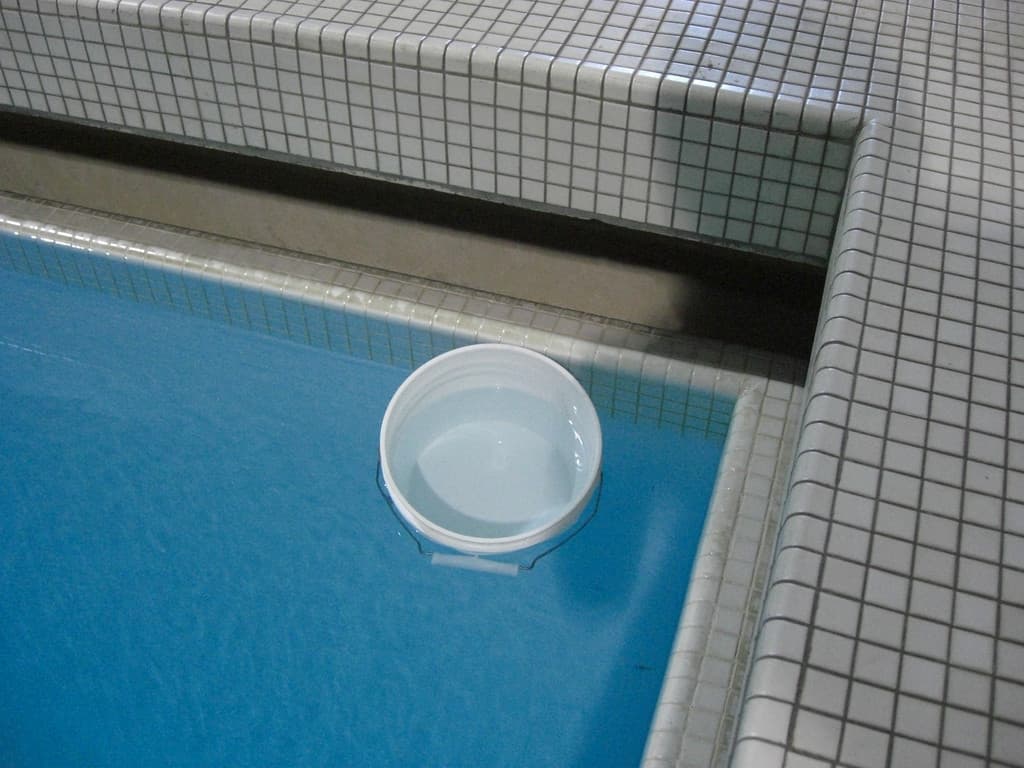
While you wait on the test, look around the equipment pad. The EPA says wet spots around the pool, or air bubbles in the water return pipeline or in the pump strainer can also be signs of leakage.[1] Tell the company what you saw.
Get quotes you can compare
The Board for Contractors tells homeowners to get at least three written bids.[4] For detection, ask each company:
- how the leak will be located, and whether that method suits your kind of pool
- whether the fee is a flat visit charge or hourly, and what a second visit costs
- what you receive afterwards, such as a written note of where the leak is and what it needs
- whether the fee is credited toward the repair if you hire the same company
- what the repair would involve, whether draining and refilling are included, and what the warranty covers
A company that cannot say how it will find the leak is hard to compare with one that can. Do not pick on the lowest figure alone; check that the quotes cover the same scope.
Check the licence and the contract
Look each company up on the DPOR website. The Board's guide says that if the work you are considering is valued at $1,000 or more, a valid Virginia Contractor's License is required for the license category in which the contractor is to work.[4] Ask each company whether detection and repair are quoted together, and what the repair is likely to total.
For a repair, Virginia law requires all licensed contractors to provide a written contract for residential work.[4] Make sure it states the work, the price, who pays for water and chemicals and what the warranty covers.
Stop and call a pro if
- The bucket test says the pool is losing water. Finding a leak is a job for a pool professional; the aim of the test is only to tell you whether one is needed.
- A company will not put the price or the scope in writing.
- The quote has no licence number, or the number does not match the DPOR lookup.
- Water is near pump, heater or light wiring. Stay clear and have a licensed electrician look at it.
- The pool is still losing water after a repair. Go back to the company with your before and after readings.
Getting help in Virginia
For the next step, read who to call to fix a leaking pool and how to find a leak in your pool. Another cost to plan for is pool pump repair. Browse pool and spa pros or see more pool equipment repair answers.
When you are ready, describe the leak and licensed local pros can quote it.
Common questions
- Is there a standard price for pool leak detection in Virginia?
- We found no Virginia source that dates a price, so we do not quote one. Prices vary with the pool, the access to the plumbing and how long the search takes. A written quote that says what is included is the only reliable number.
- Is leak detection billed separately from the repair?
- Often it is, but it depends on the company. Ask whether detection is its own fee, and whether that fee is credited toward the repair if you hire the same company to fix what it finds.
- Can I save money by testing first?
- Yes. A bucket test is free and shows whether the pool is losing more than evaporation explains. If pool water loss is greater than bucket water loss, the pool may have a leak, according to the EPA. If the losses match, you may not need a detection visit at all.
- Does the person who finds the leak need a licence?
- It depends on the work. If the job is valued at $1,000 or more, a valid Virginia Contractor's License is required for the license category in which the contractor is to work. Look the company up on the DPOR website before you hire it.
- What does a leak cost me while I wait?
- Water and chemistry. Tampa's water department says it takes about 600 gallons to fill up an average pool by 2 inches, and refilled water also needs its chemistry rebalanced. The EPA warns that small leaks can quickly turn into big leaks if they go unattended.
Sources
- [1] Jump Into Pool Water Efficiency (EPA-832-F-22-015, September 2022), U.S. Environmental Protection Agency, WaterSense. Checked October 27, 2026.
- [2] How to Check for Leaks, City of Tampa Water Department. Checked October 27, 2026.
- [3] 18VAC50-22-30. Definitions of specialty services, Virginia Administrative Code, Virginia General Assembly. Checked October 27, 2026.
- [4] What You Should Know Before You Hire a Contractor, Virginia Board for Contractors, DPOR. Checked October 27, 2026.
Want a pro to handle it?
Describe the job once. Licensed local businesses send quotes, and you pay only when you book one.
Get a quote for Pool Equipment