Why do I hear scratching in my walls at night?
Scratching, scurrying or gnawing inside a wall at night usually means mice or rats, which look for food after dark and travel along wall voids, pipes and wires. Flying squirrels, also active at night, are the other common culprit, mostly in attics and upper walls. Noise at dawn and late afternoon points to gray squirrels. Droppings and entry holes tell you which one you have.
Free to ask. Local shops send quotes, and you pay only when you book one.
By Kasra Taheri, Founder, LoclisPublished
Researched and drafted with AI, then checked claim by claim against the sources listed below before it was published. Prices and rules change; the dates beside each source say when it was last checked.
Step by step
Read when to stop and call a pro, further down this page, before you start.
Step 2: Note where it moves
Mark whether the sound is low in the wall, high near the ceiling or overhead in the attic.
Step 3: Listen and look at night
Inspect after dark with a strong flashlight and listen for gnawing, squeaking and movement.[1]
Step 4: Search for droppings
Check under sinks, in cupboards and drawers, and along baseboards near the noise for droppings and chewed packaging.[10]
Step 5: Compare the droppings
Small rod-shaped droppings point to house mice; larger capsule-shaped or curved ones point to rats.[1]
Step 6: Dust for tracks
Dust a light line of talcum powder along the wall edge and check later for footprints and tail drag lines.[1]
Step 7: Test a suspect hole
Stuff a suspected hole loosely with paper or foil and check after a few days whether it was chewed or pushed out.[1]
Step 8: Walk the outside
From the ground, look for gaps where pipes and wires enter and at vents and eaves; do not climb onto the roof.[1]
Step 9: Trap if the signs say mice
Set snap traps flush against the walls nearest the noise and the droppings.[1]
Scratching, scurrying or gnawing inside a wall after dark is usually a rodent. Rats and mice usually search for food at night,[1] and the space inside walls gives them shelter, warmth and a protected path between rooms. Flying squirrels are the other common night-time noisemaker, mostly higher up. The time you hear it, where in the wall it is, and what the animal leaves behind narrow it down quickly.
Why mice and rats end up in walls
House mice nest inside appliances, in wall and floor voids, in false ceilings and behind counters.[1] Rodents prefer to travel along edges, using their whiskers as guides, including along pipes, utility wires and rafters,[1] and they can run up almost any vertical surface, including wood, sheet metal, metal pipes and cables.[1] The run of pipes and wires inside a wall is a ready-made highway, which is why you hear them moving up and down.
The gnawing is not random. Rats and mice chew on almost everything to keep their large front teeth sharp and short,[1] so a steady scraping sound in one spot often means one is chewing on wood, wiring or a pipe.
Height is a clue to which rodent you have. Roof rats prefer to nest in elevated places, including walls and attics, while Norway rats generally nest in burrows at or below ground level.[1] Noise low in the wall near the kitchen often means mice; noise high in the walls and ceiling can mean roof rats or flying squirrels.
Other animals that make noise
- Flying squirrels. The Virginia Department of Wildlife Resources names flying squirrels as the most common culprits when squirrels take up residence in an attic, and they are nocturnal.[2] Expect light, quick scampering and sliding sounds overhead or high in exterior walls.
- Gray squirrels. Fairfax County's wildlife page describes squirrels as diurnal, with peak activity at dawn and late afternoon.[4] Noise that starts around sunrise and dies down at night is a squirrel pattern, not a mouse one.
- Raccoons. Fairfax County describes raccoons as nocturnal and 10 to 30 pounds in weight,[5] so they make heavy thumps and dragging sounds in the attic rather than light scratching inside a wall.
If the noise is overhead rather than in a wall, read what animal is living in your attic.
How to tell which one you have
Droppings. A house mouse leaves rod-shaped, pointed droppings; a roof rat leaves pointed, curved ones; and a Norway rat leaves capsule-shaped ones.[1] Look under the sink, in the back of cabinets, behind the stove and refrigerator, and along baseboards on the side of the wall where you hear the noise.
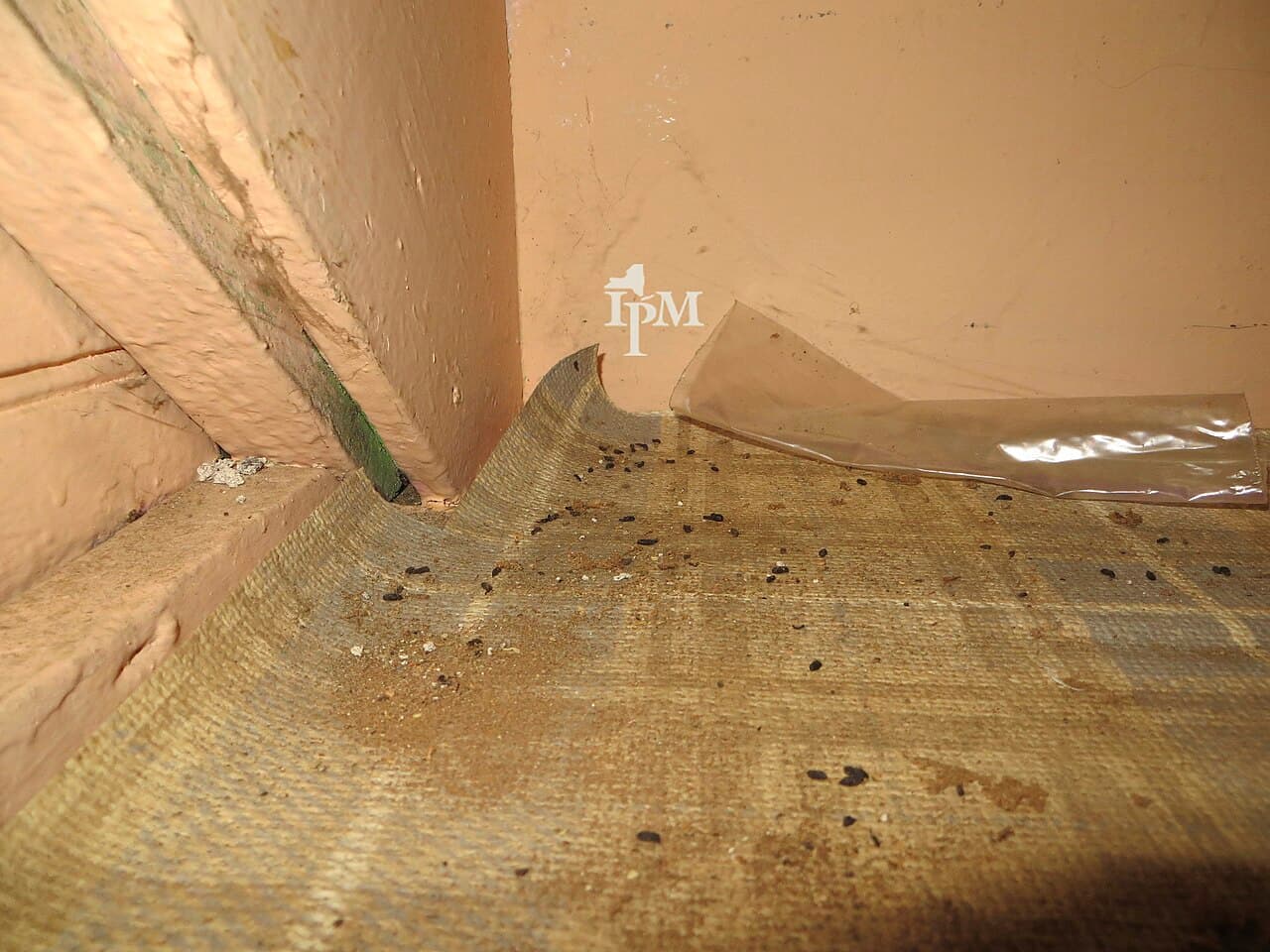
Rub marks. Mice leave brown or gray smudges along walls and other surfaces they travel over, which mark heavily used paths and entrances.[7] Check around holes where pipes come through the back of the sink cabinet.
Tracks. Rodents pass the same spots over and over, so lightly dusting the edge of a floor with chalk dust or talcum powder will show footprints and drag lines made by tails.[1] Virginia Tech's rodent guidance also suggests temporarily closing a suspected hole with paper or aluminum foil and checking after a few days whether it was removed or chewed through.[1]
Openings. A mouse can squeeze through any opening ¼ inch across, and some rats through openings as small as ¾ inch.[1] Rats and mice also get in through the eaves, the roof, attic vents and where pipes and wires go through walls.[1] Look from the ground; a round, chewed hole at the roofline often points to squirrels.
Why it is worth dealing with now
Mice are mostly active at night, and they reproduce quickly,[7] so a few become many. The bigger risk is wiring. Mice chewing on wire insulation can cause electrical shorts and fires.[1] Call a professional if electrical equipment has rodents in it or looks damaged.[8] Wild animals in the house can damage electrical wiring and destroy insulation, too.[9]
Droppings carry their own risk. Hantaviruses spread to people mainly by breathing air contaminated with rodent urine, droppings or saliva,[6] so wet droppings with disinfectant or a bleach solution and wipe them up rather than sweeping or vacuuming them dry.[6]
What not to do
- Do not seal the hole yet if the animal might be inside. For squirrels, the Department of Wildlife Resources says to make sure no young have been left behind inside before plugging the hole.[2] A trapped animal may chew a new way out through the drywall.
- Do not cut into the wall to look. Signs outside the wall usually tell you enough, and there may be wiring or plumbing behind it.
- Skip mothballs and plug-ins. Mothballs do not repel animals.[9] Mice quickly get used to regularly repeated sounds, and there is little evidence that sound, magnetic or vibrating devices drive established mice or rats out of buildings.[11]
If the signs point to mice, the fix is snap traps against the walls nearest the noise plus sealing the gaps. How to get rid of mice in your house walks through it.
Stop and call a pro if
- You smell burning, see chewed wiring, or lights flicker in the area where you hear the animal.
- The noise is heavy, happens in the daytime, or comes from the attic or roofline. Never corner a wild animal, and contact a professional if an animal seems sick or scared.[9] The Virginia Department of Wildlife Resources' Trapper Finder Tool lists licensed trappers and Commercial Nuisance Animal Permit holders near you and the species each will trap.[3]
- You find rat droppings, or the scratching continues despite steady trapping.
- A smell of something dead comes from inside a wall or ceiling.
Getting help on Loclis
Read when to call an exterminator for mice and how to keep raccoons and squirrels out of the attic. Browse rodent control services or wildlife removal services, find pest control around Blacksburg or see more pest control answers. When you are ready, tell local businesses what you are hearing and when so they can quote an inspection.
Common questions
- Is scratching in the walls at night always mice?
- Not always, but mice and rats are the most likely cause of light scratching and scurrying inside walls after dark. Flying squirrels are also active at night and are named by the Virginia Department of Wildlife Resources as the most common culprits when squirrels move into an attic. Heavy thumps point to something bigger, such as a raccoon.
- How can I tell mice from rats by the sound?
- The sound alone is hard to judge. Droppings are more reliable: house mice leave small rod-shaped droppings, roof rats pointed curved ones, and Norway rats larger capsule-shaped ones. Roof rats tend to nest high in walls and attics, Norway rats low or in burrows.
- Why does the noise stop during the day?
- Rats and mice usually search for food at night, and flying squirrels are nocturnal, so a wall that is quiet by day and busy after dark fits them. Gray squirrels do the opposite, with peak activity at dawn and late afternoon.
- Should I seal the hole as soon as I find it?
- Not until you know the animal is out. Sealing a squirrel or a litter inside can send it chewing a new way out through the wall or ceiling. The Virginia Department of Wildlife Resources says to make sure no young are left inside before plugging the hole.
- Is the noise dangerous?
- The animal can be. Gnawing on wire insulation can cause electrical shorts and fires, and rodent droppings and urine can carry disease. If you smell burning or see chewed wiring, call an electrician.
- Will an ultrasonic plug-in stop the scratching?
- Unlikely. Mice quickly get used to regularly repeated sounds, and there is little evidence that sound devices drive established mice or rats out of a building. Trapping and sealing the entry points work better.
Sources
- [1] Schools Integrated Pest Management (IPM) for Rats and Mice, Department of Entomology, Virginia Tech. Checked October 27, 2026.
- [2] Problems with Squirrels, Virginia Department of Wildlife Resources. Checked October 27, 2026.
- [3] Find a Licensed Trapper or Wildlife Control Specialist, Virginia Department of Wildlife Resources. Checked October 27, 2026.
- [4] Squirrel, Fairfax County Wildlife Management, Fairfax County Government. Checked October 27, 2026.
- [5] Raccoon, Fairfax County Wildlife Management, Fairfax County Government. Checked October 27, 2026.
- [6] Hantavirus Pulmonary Syndrome (HPS) fact sheet, Virginia Department of Health. Checked October 27, 2026.
- [7] Mice, National Pesticide Information Center, Oregon State University and U.S. EPA. Checked October 27, 2026.
- [8] Rodents, National Pesticide Information Center, Oregon State University and U.S. EPA. Checked October 27, 2026.
- [9] Problem Wildlife in the House, National Pesticide Information Center, Oregon State University and U.S. EPA. Checked October 27, 2026.
- [10] Identify and Prevent Rodent Infestations, U.S. Environmental Protection Agency. Checked October 27, 2026.
- [11] Pest Notes: House Mouse, University of California Statewide Integrated Pest Management Program. Checked October 27, 2026.
Want a pro to handle it?
Describe the job once. Licensed local businesses send quotes, and you pay only when you book one.
Get a quote from a local pro