How do I find where my roof is leaking from?
Trace it from inside, then let a roofer confirm it outside. Water often runs along rafters before it drips, so the stain is rarely under the hole. Look at the attic from the hatch for wet insulation, dark wood and stained nails, note when it leaks, and photograph it all. The roof itself is a job for a licensed roofer.
Free to ask. Local shops send quotes, and you pay only when you book one.
By Kasra Taheri, Founder, LoclisPublished
Researched and drafted with AI, then checked claim by claim against the sources listed below before it was published. Prices and rules change; the dates beside each source say when it was last checked.
This is a job for a licensed pro in Virginia
This page explains what the work involves, the permits, what a licensed pro does and what drives the cost. It does not give step-by-step instructions, because this work needs a licence, a permit or both, and doing it wrong can injure someone. Before you hire, check the licence on Virginia's DPOR record.
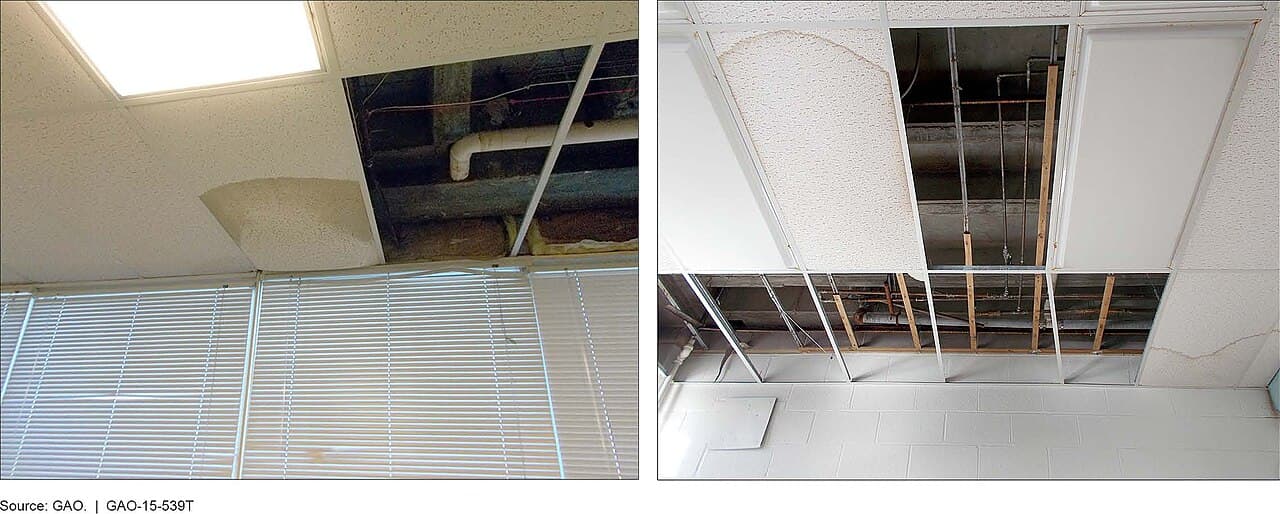
Start indoors and work backwards. Water that gets through a roof covering usually runs along the underlayment, sheathing or a rafter before it drips, so the stain on your ceiling is rarely directly under the hole. A roofer will confirm the entry point from above, but the clues you collect first make that visit faster and cheaper.
What the attic tells you
If your attic has a hatch or a floored area, you can look in without stepping onto bare joists. Bring a bright flashlight, look up at the underside of the roof deck, and check the insulation below it. The U.S. Department of Energy lists these as signs of possible water intrusion:
- Wet insulation in the attic, especially near the eaves[1]
- Mold or mildew on attic surfaces[1]
- Warped or rotting wood in the attic[1]
Dark streaks on the deck, rusty nail tips and a trail of stained wood leading toward the ceiling stain all help. Note where they sit relative to the chimney, plumbing vents, skylights and walls. DOE also lists outside signs: Bubbled paint at fascia boards or soffits,[1] and Worn or warped shingles at roof edges.[1]
Where leaks usually start
Roof leaks cluster at breaks in the roof surface. DOE lists Leaks in the roof or improperly installed flashing around chimneys and other roof penetrations[1] as one of the ways moisture enters an attic. What roof flashing is explains why these joints fail more often than open shingle fields. Other common starting points are a damaged or lifted shingle, a worn pipe boot, a ridge vent (see why a ridge vent leaks) and a skylight edge.
In winter the cause can be a different one. DOE also lists Ice dams in roof gutters causing water to seep under shingles and leak into the house.[1] How to prevent ice dams covers that pattern, which tends to show up along exterior walls after snow and a thaw.
Rule out condensation
Not every wet attic is a roof leak. DOE gives another way moisture gets in: Water vapor entering the attic from inside or outside the home, without proper ventilation for it to escape.[1] Condensation usually shows up across a wide area, in cold weather, without any rain. A leak tends to be local, follows rain or snowmelt, and often depends on wind direction. If you are unsure, how to know if your attic is ventilated well is worth a read.
For a hard-to-read case, DOE's advice is to schedule a visit by a home performance contractor,[1] who can look at moisture and ventilation together. If you suspect the roof, a roofer is the person to start with.
Keep notes that help the roofer
A leak that only shows in some conditions is hard to catch on a dry day. Write down the date, whether it was steady rain, wind-driven rain or snowmelt, and how long it took to appear. Photograph the stain with something for scale, and take a short video of any active drip. Mark the edge of a stain in pencil and date it, so a roofer can see if it is growing.
Dry the area meanwhile. EPA says that if wet or damp materials or areas are dried 24-48 hours after a leak or spill happens, in most cases mold will not grow.[3] For the first-hour steps, see what to do when your roof starts leaking.
Why the roof search is not a homeowner job
Finding the exact entry point means walking a sloped roof, lifting shingles and testing joints, often with water. That is where the falls and the damage happen. A hose test by an amateur can also push water into new places and make the picture muddier. The sound approach is to keep to the inside and the ground, and let a pro do the rest.
When to call a licensed pro
Call once you have the notes above, and straight away if the leak is active. PNNL's roofing guidance says: Roofing should be inspected and installed by a professional roofing contractor, licensed and insured.[2] In Virginia, DPOR says that if the work you are considering is valued at $1,000 or more, a valid Virginia Contractor's License is required for the license category in which the contractor is to work.[4] Check the licence on DPOR's lookup before you sign.
Ask the roofer to show you the entry point in photos, not just name it, and to put the repair and its price in writing. Who to call for a roof leak covers how to choose. Browse more roofing answers or roofing businesses, and when you are ready, describe the leak and add photos so licensed local roofers can quote it.
Common questions
- Why is the ceiling stain not under the hole in the roof?
- Water that gets through the roof covering usually runs along the underlayment, sheathing, rafters or pipes before it drips. It can travel several feet and show up at a light fixture, a wall corner or a spot with no obvious connection to the entry point.
- Could it be condensation instead of a leak?
- Yes. The U.S. Department of Energy lists water vapor entering the attic from inside or outside the home, without proper ventilation for it to escape, as another way moisture gets into an attic. Frost or droplets on the underside of the roof deck in cold weather, wet insulation across the whole attic, or a stain that appears without rain all point that way.
- Can I find the leak by running a hose on the roof?
- Leave that to a roofer. It means working on a sloped, wet surface, and a person inside has to watch for drips while another works above. Roofers do water testing in a controlled order, from the lowest suspect point upward, so one area is cleared before the next.
- What photos help a roofer find the leak?
- Wide and close shots of the stain, the attic above it, and any wet insulation or dark wood, plus a note of the date, the weather and whether it leaked in wind-driven rain, steady rain or snowmelt. A floor plan sketch showing where the stain sits against the chimney, vents and walls helps most.
- Is a drone or camera inspection worth it?
- It can help a roofer see a steep or high roof, but it does not replace checking flashing, sealant and the attic side of the deck. Ask what the inspection includes and whether you will get a written report with photos.
Sources
- [1] Guide to Durable Attics, U.S. Department of Energy. Checked October 28, 2026.
- [2] Asphalt Shingle Roofs, Building America Solution Center, Pacific Northwest National Laboratory for the U.S. Department of Energy. Checked October 28, 2026.
- [3] A Brief Guide to Mold, Moisture and Your Home, U.S. Environmental Protection Agency. Checked October 28, 2026.
- [4] What You Should Know Before You Hire a Contractor, Virginia Department of Professional and Occupational Regulation, Board for Contractors. Checked October 28, 2026.
Want a pro to handle it?
Describe the job once. Licensed local businesses send quotes, and you pay only when you book one.
Get a quote for Roofing